Rotary has three components – Rotary International, The Rotary Foundation and a global network of Rotary clubs. All work in sync, to bring about lasting change in local communities and around the world.
Rotary International is one of the largest and most influential international humanitarian service organizations in the world. Today, in 2026, it consists of over 1.4 million members (Rotarians), belonging to more than 45,000 clubs in over 200 countries and geographical areas. Rotary members are a diverse group of business, professional, and community leaders, who volunteer their time, talent and financial support, to tackle humanitarian challenges both locally and internationally.
Rotary started with the vision of one man, Paul Harris, a Chicago-based attorney, who formed the Rotary Club of Chicago on 23rd February 1905, the first Rotary Club, so that professionals with diverse backgrounds could exchange ideas and form meaningful, lifelong friendships. The founder wished to recapture in a professional club, the same friendly spirit he had felt in the small towns of his youth. The name “Rotary” was derived from the early practice of rotating meetings among members’ offices.
Rotary’s popularity spread throughout the United States in the decade that followed. By 1921, Rotary clubs had been formed on six continents, and the organization adopted the name Rotary International a year later. Its mission also expanded beyond serving the professional and social interests of club members, and Rotarians began pooling their resources and contributing their talents to help serve communities in need.
Together, we see a world where people unite and take action to create lasting change — across the globe, in our communities, and in ourselves.
We provide service to others, promote integrity, and advance world understanding, goodwill, and peace through our fellowship of business, professional, and community leaders.
The organization’s dedication to the ideal of serving communities in need is best expressed in its principal motto: Service Above Self.
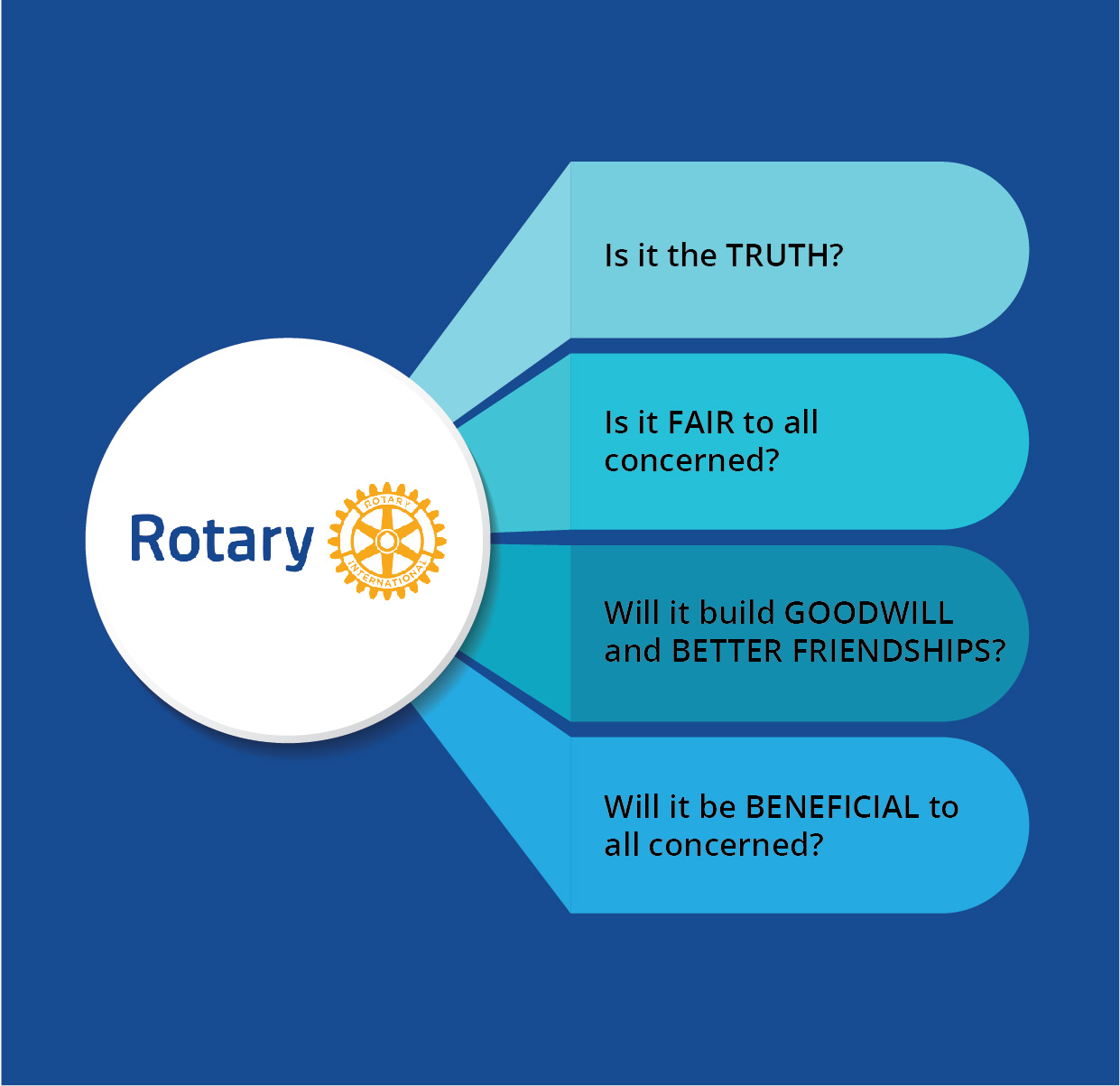
Rotary’s Four-Way Test is a code of ethics, adopted in 1943, and which is used by members to evaluate their thoughts, words, and actions. This moral compass helps ensure fairness and honesty in business and personal dealings, focusing on truth, fairness, goodwill, and mutual benefit for all stakeholders.
This code of ethics requires all members to evaluate what they think, say or do, by 4 criteria or tests:
The 4-Way Test has been translated into hundreds of languages.
The 4-Way Test has been transRotary International and its components, The Rotary Foundation and the global network of Rotary clubs, work primarily in 7 Focus Areas, listed below: