
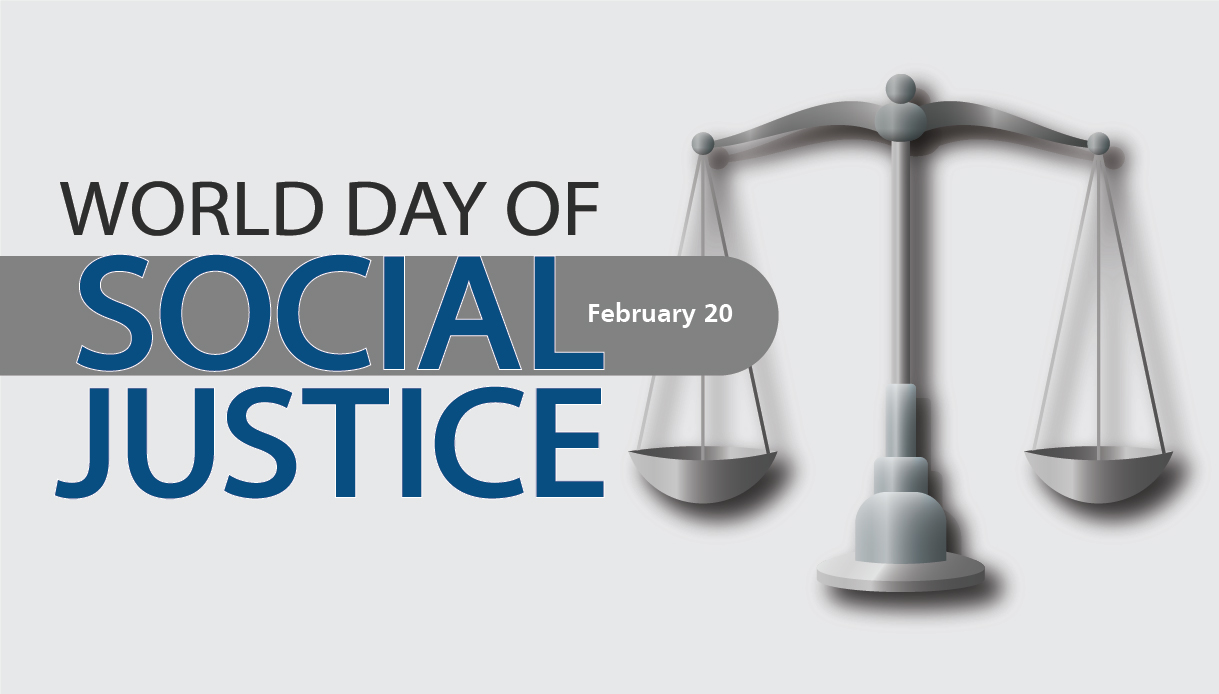
Each year on 20th February, the world observes the World Day of Social Justice, a moment not of ceremony alone, but of sober reflection and renewed responsibility. The UN General Assembly established this Day in November 2007 and it has been observed annually. Its creation reflected a growing global consensus that peace, security, and sustainable development are unattainable without justice, and that justice itself cannot exist in the absence of respect for human rights and fundamental freedoms.
The intellectual and institutional foundations of this observance are closely tied to the work of the International Labour Organization (ILO). In June 2008, the ILO unanimously adopted the Declaration on Social Justice for a Fair Globalization, which placed the Decent Work Agenda at the heart of global efforts to align economic growth with social equity. It acknowledged that while globalization and technological advances have created unprecedented opportunities, they have also deepened inequalities, exclusion, and vulnerability across societies.
At its core, social justice is neither a slogan nor a narrow economic doctrine. It is the principle that all people, without discrimination, should have equal rights and genuine opportunities to benefit from economic and social progress. As articulated within the UN framework, social justice encompasses dignity, freedom of expression, autonomy, and the fair distribution of opportunity. It seeks to remedy not only material deprivation but also unequal rules, discriminatory structures, and imbalanced power relations that perpetuate injustice.
The relevance of this agenda is reinforced by the realities of the present era. The UN has emphasized that social development and social justice are indispensable to peace and security, within and among nations, and that neither can be achieved in isolation from human rights protections. The World Day of Social Justice therefore functions as both a moral compass and a policy platform, urging collective action to eradicate poverty, promote full employment and decent work, advance universal social protection, and close widening social and economic divides.
This global commitment is closely aligned with the United Nations Sustainable Development Goals. The observance directly supports SDG 1 (No Poverty), SDG 5 (Gender Equality), SDG 8 (Decent Work and Economic Growth), and SDG 10 (Reduced Inequalities). Each of these goals underscores the indivisibility of justice from development: poverty eradication cannot occur without equitable opportunity; economic growth is unsustainable without dignified work; and social cohesion cannot be sustained amid widening inequality.
Within this global architecture, Rotary occupies a distinctive and consequential role. Rotary International approaches social justice not as an abstract ideal, but as a practical responsibility embedded in action. Through its four complementary roles—as practitioners, educators, mediators, and advocates – Rotary advances peace and inclusion across multiple domains. Rotary’s Peace Centers, which have trained more than 1,800 peace fellows, exemplify its educational mandate, while its mediation efforts in conflict zones have enabled humanitarian ceasefires for polio vaccination campaigns. At the community level, Rotary’s work in disease prevention, clean water and sanitation, maternal and child health, education, economic development, and environmental protection directly addresses the structural roots of injustice. From supporting WASH programs to expanding access to health care for underserved populations, Rotary’s interventions reflect a commitment to long-term, locally anchored change rather than episodic charity.
As we observe the World Day of Social Justice, the imperative before institutions is strategic and ethical. The pursuit of justice demands more than goodwill; it requires coherent policy, inclusive governance, and sustained investment in human potential. For Rotary and its members, this day is not merely an occasion to reaffirm values, but an invitation to deepen impact, locally and globally, through disciplined service and principled advocacy. In a world marked by profound interdependence, social justice is not an optional aspiration; it is the essential architecture of a stable and humane future.